Category: Marketing

  • Pronunciation

    From infancy onward we learn how to pronounce words by hearing others talk and from reading books. When it comes to literature, often we find words invented by the author or ones that weren’t, but we don’t frequently hear. They are often the names of people, places and things, but not always. In all cases, we are prone to mispronouncing them, out loud or just in our heads.

    Names and words can be spelled the same but pronounced differently depending upon where and from whom you hear them. For example, the name Guy in French is “GEE” (not “JEE”) as opposed to the English “GIE”. In Ireland, Saoirse is most commonly “SEER-shuh” but in certain regions “SAIR-shuh” is more popular. How you say Cairo depends on whether you’re referring to the city in Egypt (“KIE-roh”) or Illinois (“KAY-roh”).

    Some names have been anglicized in how they sound if not their spelling. For instance, Brian and Dylan, which respectively originate in Irish and Welsh myth, were “BREE-in” and “DULL-in” but have since been anglicized as “BRIE-in” and “DILL-in”. Ethnic background however doesn’t always guarantee a specific pronunciation. It ultimately rests with personal preferences. Welsh poet Dylan Thomas used the anglicized version of his first name. Actress Saoirse Ronan prefers “SUR-shuh”.

    Not every name or word is pronounced how it’s spelled either, which many Irish, and Old Irish, names demonstrate. To use one example, a letter combination (known as a diphthong) of MH or BH sounds like either a W or a V; the name Siobhan is “SHIH-vawn” and the festival Samhain (which helped create modern Halloween) is “SOW-in”. Some Welsh names beginning with an I pronounce it like a Y. The examples go on.

    Yet sometimes, a mispronunciation has with time become the correct one. Jekyll in The Strange Case of Dr. Jekyll and Mr. Hyde today is “JECK-uhl” but was originally “JEEK-uhl”. The T in Voldemort was meant to be silent, but it was pronounced in the Harry Potter films. The surname of Dr. Seuss was supposed to be “ZOICE,” but after people kept saying “SOOSE” he gave up trying to correct them.

    Mispronouncing a word when reading is nothing to be ashamed of. We’ve all been there, including me. This quote/image has been shared frequently on social media:
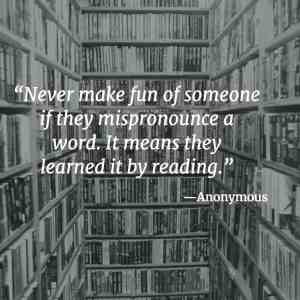
    mispronounce

    For us writers, there are steps we can take to help readers pronounce words correctly. Here are some personal recommendations. First, make sure you know the proper (or your preferred) pronunciation, especially if you think people will likely mispronounce it. If you have several names and/or words you believe will be hard to pronounce (such as within fantasy or science-fiction), it might be a good idea to include a pronunciation guide. With works where there are fewer such words, an easier method could be incorporating the pronunciations into the text or dialogue (if you’re writing for the stage or screen, actors will be enabled to pronounce them for you – just make sure you let them know how you want them said). That way, incorrect pronunciations don’t become correct ones.

    Pronunciation Sites
    Irish Pronunciation Sites
  • Social Media

    Social media is without a doubt one of the greatest technological advancements in modern times. Gone are the days when the only way to spread word by handwritten letters or word of mouth. Now in the computer age people can communicate with one another in the blink of an eye. For a writer, social media has become indispensable for informing prospective readers of theirs and their work’s presence, especially for the unknown writer trying to establish a foot in the writing world. Yet social media, like the writing world, is a vast ocean filled with fish. Each writer must find ways to make him or herself stand out.

    When I first started writing I used word of mouth to talk about it. Still, I was young and woefully unprepared for marketing (I certainly was not ready for publication either). Throughout high school I was not on social media of any kind and would really not get into it until after college.

    In addition to this website/blog, I have a Facebook page and a YouTube channel. In observing site stats, I can see it has gotten far more referrals from Facebook than anywhere else. Several friends from the Maryland Writers’ Association created a public page that anyone can like and follow. I knew at some point I ought to create one of my own, but it was not until my first writing award in the MWA creative nonfiction contest and agreeing to read from it in Baltimore that I finally got around to that. I invited all my connections to like the page, and still do.

    Almost instantly, inquiries were made on the page regarding my website. I hesitated to create one because I hadn’t published much, nor had I found a publisher for my novel. Nevertheless, I wondered if I should start early. At a meeting of the Annapolis chapter of the MWA, I talked about it with a friend. She encouraged me to start right away, so I did. Website building blogging, and specifically WordPress, were the topic of discussion at a previous meeting. So I decided to go with WordPress. I started with one visual theme, but another site I formerly followed already used it. Eventually I grew dissatisfied. I knew I needed to find something different. Eventually after looking at many other themes, I chose the one I have now. Like in all aspects of writing and social media, I have continued to learn through trial and error to refine my site’s image.

    My site’s domain name was not my first choice. I originally hoped to use my first and last name, like many writers’ professional websites. Unfortunately, it had already been taken. My first post appeared the month after I created my site. In future I hope to use my blog to make announcements about and market my work. For now, I have been discussing my experiences and beliefs I have formed about writing. I do sometimes wish there were more likes and comments, but I have learned it is not always easy to catch people’s interest. Sometimes to do so, the old ways like word of mouth are best. Still, not everyone you invite responds. Some prefer not to subscribe. It is something we all must learn to accept. No one can be forced to subscribe or even view a site. All you can do is invite them.

    Social media has a dark side too. We all must strive to remain dignified and respectful when many others will not be, which is not always easy. In the past, on Facebook, I have at times written without thinking, or were distracted or having a bad day. Some friendships were broken as a result, despite my attempts to make amends. Lesson learned; we are all people with feelings, opinions, and flaws. At times I fear I might become trapped within my own creation. I have to do my best to restrict myself sometimes; to know to when to stop. Social media can be like public appearances in that you need to guard your private life outside of them. Sometimes it feels like I spend too much time on it, and I have to be mindful there too. It is good to unplug sometimes and get away from it all, to enjoy life and discover true inspiration.

    As mentioned earlier, I am also using YouTube. I uploaded my first video back in April from the Open Mic I participated in that month. There have not been any more at the moment. In the future I hope to change that, with more appearances, book trailers, and other videos. I have created a presence on social media and acquired a following. I sometimes fear I will run out of ideas to blog about before a publisher accepts my manuscript. I can only hope this platform will continue to grow, and that I will continue to learn new ways to market my work and presence, so they stand out.

  • Off the Page

    Writers must play a role in marketing their work, so that prospective readers will know about it, and them as writers. Central to that role is taking their written words off the page by reading aloud. Sometimes there are full-length reads in person, or short clips meant to entice readers to want more. Writers also speak publicly about their experiences as writers. In all cases, it is important to give a strong presentation.

    Before stories were written, they were told aloud. We still read them aloud today. As a child my parents read to me before bed, which I hope to do someday when I have children of my own. Some of my favorite TV shows were essentially narrations of the stories they were based on, from Beatrix Potter’s tales to The Railway Series by Reverend Awdry (these were narrated by George Carlin and Ringo Starr). The narrators I remember did an excellent job. I watched them over and over again. Those stories stuck with me. In recent years when I volunteered at a library annex on Ft. Meade, once in a while I read aloud to visiting children. Listening to and telling stories are a way we can connect to each other.

    In school I read my work aloud, which continued at St. Mary’s. I listened to writers talk as part of the college’s VOICES reading series. Back in high school I participated in the drama club, where I had to memorize lines. Public readings and talks are themselves a dramatic performance. Therefore, the writer is an actor playing a role. Charles Dickens gave numerous readings of his work (notably A Christmas Carol). He actually considered becoming an actor before he started writing. Nevertheless, he was a master of vocalizing characters. It has been sadly noted his time was before voices could start being recorded, so we can never hear what he sounded like.

    My mother told me I could once recite Dr. Seuss’s The Cat in the Hat from beginning to end. I have no memory of that sadly, but I certainly have been able to quote works I have read. At work I’ve done so when people check out those works, such as Shakespeare. In my junior year of high school, I participated in a Poetry Out Loud contest where I recited Shakespeare’s famous Sonnet XVIII: “Shall I compare thee to a summer’s day?”. Although I froze near the end, I managed to save my performance and ended up winning third place.

    The first time I read from my work that was published was back in September at the Baltimore Book Festival, for my creative nonfiction essay on Asperger syndrome. In analogy to King George VI, that reading could be considered my Wembley speech. Though I dressed the part of a writer (someone there even commented so) right down to the Tweed jacket, I did not prepare well at all. I had to select which excerpts to read then and there. Also, in choosing I could see parts I felt could have been written better, and in the end, I rushed through it, flustering.

    People still enjoyed it, but I knew it could have been better. Pictures taken that day show me looking frustrated. To the superstitious, I guess it did not help that a black cat crossed the road as I was preparing to leave for Baltimore (no joke; that really happened). That day was a lesson to never be totally unprepared. The next reading, I knew had to be better. When I agreed to participate in an open mic event back in April, I repeatedly recorded myself reading using an app on my iPhone. I listened to myself, noting where I needed improvement. After the final reading it and watching the video recording of it, I felt satisfied. I hope the next public reading will be better, and every one to come.

    Author, teacher, speaker and voiceover artist Izolda Trakhtenberg discussed the importance of speaking well at the Annapolis MWA meeting last week. She showed us different exercises to help in preparation for reading aloud. In many ways they reminded me of Geoffrey Rush’s portrayal of Lionel Logue in The King’s Speech. She showed us a writer needs to have good vocal presence, posture, balance, breathing, and must connect with the audience by maintaining eye contact. Regulated breathing helps you speak better. Eye contact has always been difficult for me, with my Asperger syndrome.

    I and others at the meeting read a few lines of dialogue from published or unpublished work. In my case, I read from an early scene in my novel, during the protagonist’s first meeting with his eventual mentor. Izolda mentioned I started strong but went softer and mumbled. Would that not have happened had I practiced? Perhaps. Still, I was complemented for using a lower pitch of voice for my mentor in contrast to my protagonist to show who was more confident and self-assured. She suggested to all of us that we record samples of different vocal tones so to remember them for specific characters.

    Public appearances are important. Now I don’t want my presentation of myself to become my life. I hope to live a private life away from public eyes, so it in turn can truly inspire my work. Nevertheless, I hope to do more readings so people will know me and my work. I’m sure there will be mistakes, but I accept that. Everyone makes mistakes, including me. The best I can do is minimize them as much as I can.