Yes! I’m very happy to announce that the paperback version of Mystical Greenwood is now available on Amazon!
Mockingbird Lane Press will also soon be offering an e-book version (which can be downloaded to Kindle and Nook)! It should be available in a couple weeks.
Mystical Greenwood will also soon be offered on Barnes & Noble.
I hope you enjoy it! Please read, review (be honest), and help spread the word!
The cover art is also available on Deviant Art! If you’re a fan, you can now buy merchandise!
I’m sure many of you are eager to hear the status on Mystical Greenwood. So as a little treat on this Christmas Day I thought I’d share some updates.
To begin with, if you haven’t yet, be sure to watch the book trailer!
Many thanks to Jamie Johnson of Mockingbird Lane Press for an excellent job, and also to songwriter Lee Chapman for the wonderful musical score. Some of you already know this, but Mystical Greenwood includes within its story the lyrics I wrote for two songs. Lee has composed music for both of them. The music in the trailer is for one of those songs.
I’ve gotten through the hard proof round of editing. It sure was a thrill to hold my book in my hands. I do not have an official release date yet, but it looks like Mystical Greenwood may be ready sometime in the coming months! I’ll make an announcement when it’s available. The cover art should follow on Deviant Art soon after the book’s publication.
As you saw from the trailer, when it’s officially released, it will be listed on Amazon and Barnes & Noble. It will be available in both paperback and e-book (downloadable to Kindle and Nook). Be sure to check the Events page for future events. I definitely want to organize a launch party once the book is released.
I’m looking forward to the new year! Once again, I’m thinking of resolutions. Those pertaining to writing include completing at least one draft of a new book (specifically those two that are in progress), and of course making Mystical Greenwood a success. You can help me there by reading it, reviewing it, and spreading the word.
Tomorrow marks this website’s second anniversary. Wow, two years already! Looking back, it’s amazing how much has happened since I created it, much of which I couldn’t have anticipated.
This blog post is my twenty-fourth. I chose to pace myself at one a month, which has suited me fine so I wouldn’t run out of ideas too fast. I’ve discussed personal insights and experiences in various aspects of the writing process as a means to get the word out about myself as a writer, to share my opinions, and to build a following in advance of getting my novel published. All are listed under the site’s Blog page.
My first blog post was referenced in a superbly done lecture series by Professor Jennifer Cognard-Black, titled Becoming a Great Essayist. I highly recommend it for any writer. My post may not have been an essay, and I certainly didn’t think of it as such when I wrote it. But maybe some of those that have followed it meet that level.
I completed writing Mystical Greenwood shortly after creating this site, and by the end of the following year, I signed a contract with Mockingbird Lane Press to publish it. The cover art was completed this summer, and my publisher and I have worked together on editing it.
Two haiku poems were published last winter in the MWA‘s literary journal Pen in Hand, which is available on Amazon (again, my author bio has an old web address). I’ve also done early work on two other novels, which I hope to get back to over the holidays.
My website has been viewed by people all over the globe. Ranked by most views, here’s a list of the top ten countries as of this moment:
United States
United Kingdom
Canada
India
Brazil
Australia
Ireland
Spain
Tanzania
Italy
I’ve shared my site and posts on social media, and made new accounts to increase the viewing pool. I’ve also uploaded two videos of me reading samples of my work publicly to my YouTube channel.
With Thanksgiving approaching, I’m thankful not only for getting my novel on its way to publication, but to have done well with this website over these two years. I’m also thankful to all of you who followed this site and liked my pages and posts.
Who can say what will happen in the upcoming year? With Mystical Greenwood coming closer to publication, I look forward to it! If you’re reading this and aren’t subscribed or following me on social media, I hope you’ll consider doing so and joining in on this journey!
If you have a website and/or blog, how long has yours been up? Please share some of your own writing and blogging highlights.
Any writer who takes their craft seriously will have edited their work many times over. I can pretty much guarantee that any bestselling novel or literary classic you take off the shelf is not in its first draft. Novels go through several drafts before they are published. It can be said of any form of creative writing too, really. It can even feel at times while you write that you are editing too, and the editing takes over the writing process. Some say to not edit at all with the first draft, to just write it and get it done. Also, others will say that you eventually have to stop editing and move on, otherwise you never will. Both of those sentiments make total sense, but editing is still a vital stage of the writing process.
Perhaps you remember from writing school papers the concept of rough drafts and final copies. Editing enables you to polish a rough draft so that you have a final copy. It is the same with novels. So what chance does a work have without being edited, or without at least one other pair of eyes not your own offering critical feedback? Taking feedback is never easy, but it should be constructive, so you can see it as a way to ask yourself what can be done better.
Going beyond grammar and spelling, the book itself goes through many drafts. Plot points are altered. New ones come in. Old ones are eliminated. It’s same with characters, names, and the elements and rules of world-building. Plot holes are identified, along with anything that does not fit. The problem is tackled, usually more than once. It might be necessary to start over from scratch, using the old draft for reference. Format can change too: chapter titles come and go, length can be altered, and the format of chapter numbers (word numbers, Roman numerals, number numbers) can change.
With Mystical Greenwood, I’ve learned the power and importance of editing. It’s always beneficial to have another pair of eyes look at what you wrote, so you might see what potential readers might say. Whether they’re beta readers, critique group members, or professional editors, their opinions will go a long way. At a time when I thought Mystical Greenwood was good and the plot solid, an insightful and encouraging critique from author John DeDakis showed me that more work still needed to be done. To quote Ewan McGregor’s character in The Ghost Writer, I came to think of it as a case where “all the words are there. They’re just in the wrong order.” Some scenes were moved around and rewoven together as a result.
Originally, I had around half as many chapters that were twice as long, but then I started to wonder if they were too long. I’ve read books with really long chapters and found it to be frustrating finding a place to stop before bed. So about two thirds through a draft, I split those I had in two (excepting the prologue). I also switched from word numbers to number numbers. I once had chapter titles, but grew to dislike them, and after failing to think of new ones, I discarded them altogether. I felt they had become unnecessary.
The main reason I approached Mockingbird Lane Press was its founder, Regina Riney-Williams, has a great reputation as an editor. Over the course of two rounds of editing, I have found her insights and opinions invaluable. She has been constructive and encouraging, and I’m very grateful for her feedback as much as her willingness to take my book on. I’ve learned not only that so much can change through editing, but as a writer to never stop with one draft. To be a good writer, one must seek and accept feedback, subsequently editing, revising, and often rewriting, which must continue with every novel to come.
I’m very happy to reveal the cover art for Mystical Greenwood! Many thanks to Jamie Johnson of Mockingbird Lane Press for her excellent design!
I’m also delighted to announce it will be available before long on Deviant Art, where items can then be purchased with the cover art on them!
The cover art is sadly the property of the publisher and can no longer be displayed on this site, as the publisher has had to shut down. I apologize for the inconvenience.
Writing an entire book is a challenge, but one I have overcome with Mystical Greenwood. It isn’t finished yet technically as it’s still in the editing phase. But with Mockingbird Lane Press publishing it, it’s more apparent to me than ever that the day will come where I’ll have officially moved on from this one book I’ve worked on for so long. But that means I’m going face a new challenge, which may prove even greater: writing another book. Knowing I’ll have to move on to this next step, I’m already feeling the pressure.
It almost feels as if I’ve never written a novel before. I’ve noticed a similar situation in college: whenever a new semester starts, it feels like I’m back to square one. But in truth, I realize it’s only natural to feel this way, because every semester, like every book to come, will be different. Each new novel will be its own unique experience and journey, but I’ll have to remember the experiences and challenges will be, to a certain degree, similar to those I’ve endured before. I have to tell myself I did it before and can do it again. On the other hand, it may be necessary as well as only natural to feel nervous. I cannot become overconfident or complacent with myself. That fear of failure is what enables me to keep striving try hard, and be conscientious.
However, I find Mystical Greenwood as it is now – almost complete – in the back of my mind. As a result, I keep thinking about it, which isn’t a fair comparison because newer projects will be in their earliest, rough drafts. Sometimes I feel people, when reading a novel, don’t consider the earlier drafts it must’ve gone through. Speaking for myself as a writer, I see a similar problem when starting a new novel after finishing the last one. It’s easy to look at a book, complete or nearly complete, and fear your next one won’t be as good or well-written. On the other hand, that last book was rough once. What I mean to say is, Mystical Greenwood‘s near publication should motivate me to write more, but I can’t compare it to other novels as I begin writing them. The books to come will also take more than a few drafts. A well-polished book doesn’t come instantly.
As I have said before, Mystical Greenwood is intended to be the first book in a trilogy. The next book certainly is one of those up front I need to work on. I have some ideas already forming of what I want to include in the second book, including how I want to end it, but it won’t conclude the story, thereby giving me an early purpose for the third book. At the same time, I want to expand beyond this fantasy realm into other genres.
As a matter of fact, I wrote a manuscript for a high-level creative writing class during my last semester at St. Mary’s College. The class was a “novella” class, but others felt the story I came up was more novel length, which I felt too. Unlike Mystical Greenwood, it was set in the real world, and was about pets that are neglected and abused. It was definitely a first draft that needs rewriting and I want to work on it. We’ll see what happens. I don’t want to overstretch myself by working on way too many projects at the same time, but there are several other ideas I could expand on eventually. I won’t reveal too much just yet, except there is hope. The day will come soon where I’ll be moving on to the next step. I cannot stop at only a single novel. I must write more, again and again.
From infancy onward we learn how to pronounce words by hearing others talk and from reading books. When it comes to literature, often we find words invented by the author or ones that weren’t, but we don’t frequently hear. They are often the names of people, places and things, but not always. In all cases, we are prone to mispronouncing them, out loud or just in our heads.
Names and words can be spelled the same but pronounced differently depending upon where and from whom you hear them. For example, the name Guy in French is “GEE” (not “JEE”) as opposed to the English “GIE”. In Ireland, Saoirse is most commonly “SEER-shuh” but in certain regions “SAIR-shuh” is more popular. How you say Cairo depends on whether you’re referring to the city in Egypt (“KIE-roh”) or Illinois (“KAY-roh”).
Some names have been anglicized in how they sound if not their spelling. For instance, Brian and Dylan, which respectively originate in Irish and Welsh myth, were “BREE-in” and “DULL-in” but have since been anglicized as “BRIE-in” and “DILL-in”. Ethnic background however doesn’t always guarantee a specific pronunciation. It ultimately rests with personal preferences. Welsh poet Dylan Thomas used the anglicized version of his first name. Actress Saoirse Ronan prefers “SUR-shuh”.
Not every name or word is pronounced how it’s spelled either, which many Irish, and Old Irish, names demonstrate. To use one example, a letter combination (known as a diphthong) of MH or BH sounds like either a W or a V; the name Siobhan is “SHIH-vawn” and the festival Samhain (which helped create modern Halloween) is “SOW-in”. Some Welsh names beginning with an I pronounce it like a Y. The examples go on.
Yet sometimes, a mispronunciation has with time become the correct one. Jekyll in The Strange Case of Dr. Jekyll and Mr. Hyde today is “JECK-uhl” but was originally “JEEK-uhl”. The T in Voldemort was meant to be silent, but it was pronounced in the Harry Potter films. The surname of Dr. Seuss was supposed to be “ZOICE,” but after people kept saying “SOOSE” he gave up trying to correct them.
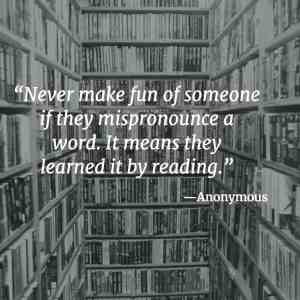
Mispronouncing a word when reading is nothing to be ashamed of. We’ve all been there, including me. This quote/image has been shared frequently on social media:
For us writers, there are steps we can take to help readers pronounce words correctly. Here are some personal recommendations. First, make sure you know the proper (or your preferred) pronunciation, especially if you think people will likely mispronounce it. If you have several names and/or words you believe will be hard to pronounce (such as within fantasy or science-fiction), it might be a good idea to include a pronunciation guide. With works where there are fewer such words, an easier method could be incorporating the pronunciations into the text or dialogue (if you’re writing for the stage or screen, actors will be enabled to pronounce them for you – just make sure you let them know how you want them said). That way, incorrect pronunciations don’t become correct ones.
Among the genres I intend to try my hand at is historical fiction. Within this genre, the characters witness actual events from our past. Some could be real figures (or based on them). Often books and movies include the subtitle based on a true story. I’ve noticed with literary and cinematic successes there’s often a subsequent wave of interest and research aimed at separating fact from fiction. For a writer, the dilemma presents itself beforehand. With the goal of telling a story and telling it well, can historical fact get in the way of telling good historical fiction? How far should writers go if they cross the line?
Fiction can actually run the risk, with time and new generations, of becoming thought of as fact. In my junior year at St. Mary’s College, I took classes discussing how literature and history have been analyzed and interpreted. In the latter, I recall us discussing how history has been “romanticized” even in America. People record events with their own beliefs and motivations. It’s human nature. To this day there have been cases where real events and figures were altered, or the truth stretched, to create a better story. Facts are sometimes selectively preserved or obscured altogether.
Fiction being fiction, some lines will be crossed. But some writers, like Rafael Sabatini, believe historical fiction should be kept close to fact. Sabatini used real events and drew inspiration from a number of historical figures when writing Captain Blood. Another novel that has been criticized for historical inaccuracies is Ivanhoe. Though several historical points ARE accurate, compared to some of his other novels it seems Sir Walter Scott took liberties. However, he DID admit he had taken liberties when Ivanhoe was published in the book’s “Dedicatory Epistle”. Some believe he wanted to reflect both his support for British unity and his Scottish patriotism through the book’s Saxon-Norman conflict.
Folktales and legends are a part of human culture and the human psyche. We need something to believe in so we may strive and rise to something better. In America, it has been noted we root for underdogs and rebels as symbols of freedom. Pirates and Wild West outlaws were almost exclusively thugs and killers. Nevertheless, they’ve been popularized as romantic heroes. Captain Charles Johnson’s 1724 book A General History of the Pyrates has had a considerable influence defining how we perceive pirates today, along with Robert Louis Stevenson’s Treasure Island. However, some believe Johnson used artistic license. Pirates seldom buried gold. More often they sold stolen commercial goods on the black market and spent all their money on vices.
My father pointed out to me a common observation that history is written by winners. This notion is especially apparent to me, together with how fiction can become fact over time, in William Shakespeare’s Richard III. I remember the news story of how Richard’s skeleton was found beneath a parking lot. I subsequently learned there are societies who believe he was wrongfully maligned by history and Shakespeare. In the play, he is depicted as an evil, scheming tyrant who has his nephews murdered after usurping the throne from them, as well as harboring an incestuous desire for his niece.
But was Shakespeare to blame? When he wrote Richard III, he was living under the reign of Elizabeth I, the granddaughter of the very man who overthrew Richard. Henry Tudor, who became Henry VII, had to justify why he took the throne. What better way than by painting his defeated opponent as a villain by playing upon rumors of Richard’s nephews’ disappearance or incestuous desire (that rumor Richard had denied)? We still don’t know for certain what befell the Princes in the Tower, although Richard certainly had opportunity and motive. By Shakespeare’s time, this image must have been considered fact. Even if Shakespeare doubted it, he almost certainly couldn’t offend his own monarch’s grandfather without putting his neck on the line.
In other cases, however, Shakespeare, whose living depended upon entertaining the masses, did deliberately ignore fact or simply filled gaps. In King John, the hero is Richard the Lionheart’s illegitimate son, Philip Falconbridge. He did actually have an illegitimate son, named Philip of Cognac. Yet little is known of him, not even his mother’s name. Shakespeare took the name and father then created his own character. In Henry IV Part I, he made Harry “Hotspur” Percy and Prince Hal close in age so they would be better character foils, when Percy was actually many years Hal’s senior.
There are exceptions to the rule of winners writing history. At St. Mary’s I took another class on the Lost Cause. Ex-Confederates initiated the movement after losing the American Civil War to whitewash their image as heroic, conveniently ignoring slavery and racism. Once again, it is a case of people recording events with bias.
As readers, we must bear in mind fiction is fiction. Historical fiction and drama shouldn’t be taken completely at face value. But that doesn’t mean writers should ignore historical fact either. I want to try and reconcile my respect for history and the goal to tell a good story well as much as possible. I know it won’t work in every way, but I’ll do my best to be accurate, particularly with worldbuilding, and any real events or figures should I use them. When I cannot be accurate, I will acknowledge it. Good historical fiction is built upon historical fact. Fiction in turn can inspire a search for the fact.
I’ve always been a fan of horror fiction, and every October I watch scary movies all month long. During my first semester at St. Mary’s College, I took a Freshman Seminar called Victorian Monsters and Modern Monstrosities. Professor Jennifer Cognard-Black introduced us (we came to be known as “Marvelous Monsters”) to six archetypes. With each we read a corresponding literary classic:
Freak – Frankenstein
Madwoman – Jane Eyre
Schizo – The Strange Case of Dr. Jekyll and Mr. Hyde
Horrorscape – Alice’s Adventures in Wonderland
Deviant – Dracula
Animagi – The Island of Dr. Moreau
Here are some of my notes from the start of the seminar regarding core themes:
Indeed, these archetypes reflect Victorian social fears and limits. Yet there is something about what’s considered monstrous that draws people in. We delight in feeling terrified. We are interested in the unknown. During Victorian times revolutions were underway in science and philosophy. The establishment clashed with the Enlightenment.
The Freak is considered, as I wrote in my notebook, the “embodiment of cultural anxiety”. Freaks are the ultimate outsiders, who can never fit due to a social abnormality, physical or not. Dr. Frankenstein’s creation is a result of his desire to know higher truth. Yet, out of fear for what he achieved, he abandons his creation. The creature longs to be human. Born innocent, he teaches himself by observing them. Yet they ultimately reject him. Mary Shelley was shunned for being her eventual husband’s mistress while he was still married to his first wife. Shunned himself, Frankenstein’s creation becomes a raging and vengeful monster, but only because society made him one. He still has a heart and feels guilt.
The Deviant can infiltrate society and take it down from within, without guilt. Count Dracula moves to London and attacks young well-born women, who symbolize what is valued by Victorian society. After the character Lucy is vampirized, she attacks children, representative of society’s future. The vampire deviates from social norms through murder and raw sexuality (something Bram Stoker could only reference indirectly in his time), and operates secretively. Yet Dracula is from a different world than Victorian London. His is one of superstition, presenting a clash between Christian and non-Christian. Exotic landscapes and languages are seen as beautiful yet terrifying. Though Victorians saw themselves as cosmopolitan, they enjoyed expressing exotic tastes. Stoker merged old and new, drawing from folklore while using a contemporary setting.
Sometimes what is deviant to one culture is not to another. A Horrorscape can be seen as a Deviant story in reverse. After tumbling down the rabbit hole, Alice enters a world where everything that defined hers, her whole cultural upbringing, is turned upside down. Everyone’s mad. Alice tells the caterpillar she’s not herself. She cannot conform. She’s transgressive. Perhaps the inhabitants of Wonderland saw Alice as a Deviant trying to tear down their world.
The notion of giving in to one’s “animal” instincts is most clearly depicted in Animagi. They represent a move away from rational towards emotional, thus revealing the beast hidden within, which is violent and aggressive. Dr. Moreau’s creations blur the boundary between man and beast. Another famous example is the werewolf. Often those animals personifying evil are feared, exotic predators. Such instincts can be classified as Christian deadly sins: greed, gluttony, anger, and lust. Yet there is something appealing about giving in: a sense of freedom. H. G. Wells defied convention by advocating “free love,” and was notorious for his affairs.
The schizo is the ultimate human split between good and evil, yet it is often unclear which is the true personality. Though Jekyll’s desire to know the unknown results in a physical transformation (which is not required for schizos), it can exist solely within the mind), even if Hyde is guilty of crimes Jekyll would never commit, Hyde is still a part of him, and slowly takes over. It calls into question identity itself. Identity is in turn reflected in residency and possessions. Jekyll lives in a respectable, cosmopolitan neighborhood; Hyde’s is far less respectable. Once I watched a documentary discussing how Robert Louis Stevenson’s birthplace, Edinburgh, was a city divided between old and new, rich and poor, suggesting that duality may be what inspired his story.
Victorians had a dual perspective regarding women, at a time when many like Shelley’s mother began challenging the status quo and seeking rights in what was still a male-dominated world (a world in which Shelley published anonymously while Charlotte Brontë and her sisters used male pseudonyms). On one side was virginity, marriage and motherhood. On the other were Madwomen: temptresses, mistresses, witches – women who played upon men’s desires, using their femininity for selfish, nefarious purposes. The lunatic Bertha Mason prevents Jane Eyre from marrying Rochester because she’s his wife (though she would later be portrayed as a victim in Wide Sargasso Sea). She dominates Rochester through marriage. Madwomen seek power over men, and greater knowledge (tied back to Eve in Eden). Women were linked symbolically with Nature because of their ability to bear children. Sometimes madwomen were associated with water and drowning, though Bertha herself dies by fire.
People are inexplicably drawn to what terrifies them. These fears and anxieties live on today. There are still outsiders, some by choice and others who have none. Criminals deviate. We all struggle with primal urges and desires. Wherever there are rules, there are always rebels. Perhaps that is why we still enjoy horror fiction. That seminar was the highlight of my first semester. I loved it. Hopefully someday I’ll apply some of these themes to horror stories of my own.